Philip Air is a global supplier of commercial cabin interiors, seats, IFEs, PSUs and other difficult to find interior components.
We also supply commercial, and military engines, engine parts, airframe, rotables and piece parts, QEC components such as starters,
generators, CSD's, and hydralic pumps as well as CSD and ACM piece parts. The company also monitors and manages engine and,
component repairs.

PHILIP AIR INC
4075 Malaga Ave. Miami, FL 33133
Tel. 305-667-4488
Email:
sales@philipair.com
www.philipair.com


Return to: www.philipair.com

Friday, July 22, 2011


§  American splits jet order between Boeing and Airbus
American Airlines announced plans to split an order for 460 jets between longtime supplier Boeing and European manufacturer Airbus. American ordered 200 737-class jets from Boeing, as well as 260 A320 aircraft from Airbus. "We'll have the youngest fleet among our U.S. peers within five years as a result of this deal," said Tom Horton, the president of American Airlines' parent company. CNNMoney.com (7/20), USA TODAY/The Associated Press (7/20), The New York Times (tiered subscription model) (7/20) LinkedInFacebookTwitterEmail this Story
§  Republic Airways CEO expects Frontier to be profitable
Bryan Bedford, the president and CEO of Republic Airways, wrote in an e-mail to company employees that he expects Frontier Airlines to be profitable in the second half of 2011, despite losing about $10 million in revenue due to a recent storm. Frontier was forced to cancel numerous flights as 18 of its planes were damaged on July 13 by a hailstorm in Denver. American City Business Journals/Denver (7/19) LinkedInFacebookTwitterEmail this Story
§  AMR announces plans to spin off American Eagle
AMR Corp., the parent company of American Airlines, today announced plans to spin off American Eagle. The regional carrier launched its first flight in 1984 and now has a fleet of about 281 planes. AMR did not offer a timeline for the spinoff. ABC News/The Associated Press (7/20) LinkedInFacebookTwitterEmail this Story
§  American Airlines reports wider loss for Q2
American Airlines reported a loss of $286 million for the second quarter, compared with a loss of $11 million in the same quarter of last year. The loss exceeded analysts' estimates. Meanwhile, American also announced plans to shutter a call center in Dublin. TheStreet.com (7/20), The Irish Times (Dublin) (7/20) LinkedInFacebookTwitterEmail this Story
§  Other News
·         Chase launches new United Airlines-branded credit card
Houston Chronicle (7/19)
LinkedInFacebookTwitterEmail this Story
Airlines kick off autumn airfare sales
Los Angeles Times/Daily Travel & Deal blog (7/19)
LinkedInFacebookTwitterEmail this Story

Tuesday, July 19, 2011


Brite Air Miami.  Guaranteeing Superior Service.
http://www.flyacc.com/emailcampaigns/briteair201106/images/border.jpg
Escape Slide-Raft A320  
Exchange or Rental
Photo - Escape Slide attached to A320

For A318, A319, A320, A321

D30664-309 SLIDE/RAFT Forward door
(DOM less than 15 years)

D30665-309 SLIDE/RAFT Aft door
(DOM less than 15 years)
Photo - Escape slide close-upSolve your short-term and
AOG slide problems 


Contact Wally Lord
305-667-4488
wallylord@briteair.com
Brite Air - Miami, FL,
www.briteair.com

Escape Slide-Raft A320 Exchange or Rental


Escape Slide-Raft A320   Exchange or Rental
For A318, A319, A320, A321

D30664-309 SLIDE/RAFT Forward door
(DOM less than 15 years)

D30665-309 SLIDE/RAFT Aft door
(DOM less than 15 years)
Photo - Escape Slide attached to A320
Solve your short-term and
AOG slide problems 

Sales@philipair.com305-667-4488

Friday, June 3, 2011

A320 passenger-to-freighter conversion program suspended

Note: The following article is excerpted from the current issue of Cargo Facts Update. We encourage those of you who do not already subscribe to the weekly Update, and its companion the monthly printed Cargo Facts newsletter, to click here for more information.

Many separate industry sources have independently told Cargo Facts that the A320 passenger-to-freighter conversion program is about to be postponed, with an official announcement expected today (Friday 03 June).

As it currently stands, the program is spearheaded by Airbus Freighter Conversions (AFC), a joint venture of EFW (EADS’ MRO and conversion arm), Airbus, and Russian aerospace companies UAC and Irkut, with EFW holding a 32% stake, Airbus 18%, and the two Russian firms holding 25% each. The program was launched with an order for up to 30 conversions from Netherlands-based lessor AerCap, however, Cargo Facts believes that at least one other order was in late-stage negotiation at the time of the program's suspension. The only end user so far identified by AerCap is Sweden-based West Atlantic, which had agreed to take three A320Fs, one in 2012, and the remaining two in 2013.

The conformity aircraft (ex-Tunisair, msn 211) was inducted at EFW’s Dresden facility in April (although actual conversion work was not scheduled to start until later this year). 

Wednesday, May 25, 2011

Denver (CO) KCNC: Tonight At 10: CBS4 Investigates Outsourcing Airline Maintenance . More   -

Monday, May 16, 2011

Air France 447: The Cost of What We’ll Learn

By Robert Mark on May 1st, 2011
There is some good news to report as we approach the two year anniversary of the the Air France 447 accident in the South Atlantic during the late evening hours of May 31, 2009. An unmanned submarine exploration team headed by the Woods Hole Oceanographic Institution – the same group that found the Titanic – located the flight data recorder from Air France 447 on the ocean floor in 12,000 feet of water.
Flight recorderThe flight disappeared without a distress call, other than a few last-minute computer-generated messages announcing electrical issues, some 750 miles northeast of Brazil that night taking 228 men, women and children, residents from 32 countries, to their death.
Two years later, there is little more than speculation about what brought the aircraft down offering few opportunities for closure of any sort to the grieving families, nor Air France, Airbus, the French BEA or anyone else wondering how and why. The recorder may offer some hope, provided it has not been damaged by two years of exposure to the sea.
An Abundance of Theories
Not surprisingly, there has been plenty of speculation. The flight plan called for the Airbus A300-200 to depart Rio de Janiero for Paris along a route that would drive  it squarely through the Intertropical Convergence Zone (ITCZ), an area near the equator with nearly calm upper-level winds. That lack of wind makes weather behave a bit differently from what we normally see in latitudes further north.
A translation from pilot-speak means that in the warm, moist air of the region, thunderstorms often grow unrestricted to enormous heights, some considerably more than 10 miles above the ocean surface making them impossible to fly over.  Significant lines of storms were forecast along the route the Airbus planned to fly that evening, leading some to initially believe the experienced crew flew directly into the storms, or at least too close to them. Other experts believe the initial wreckage recovered indicates the aircraft hit the water in-tact, but at an enormous speed partially debunking the thunderstorm concept. Without solid data from the flight recorders, everything though, is likely to remain simply speculative.
The Cost of Answers
I chatted not long ago with Matt Bradley, vice president of business development at Vancouver-based Flyht, a commercial aviation data collection and delivery company. I was more than a little surprised to learn that we could have had some useful answers about Air France 447 before the aircraft hit the water that night if real-time data streaming equipment had been on-board. Not long after I mentioned a similar idea in a June, 2009 TV interview on WGN, a source told me the technology was non-existent, as well as impractical.
After talking to Bradley, I wondered how a better understanding of the accident two years ago might have changed the industry. Would we have changed the A330 airspeed probes or was that simply a great sound bite? Was it some operational issue that took the aircraft outside it’s normal performance envelope? Was it the way the pilots attempted to penetrate to thunderstorms that was the problem? Imagine if we’d known the answers two years ago.
Bradley – an A330 pilot himself – said not only does the data-streaming technology exist now, but that it did at the time of the Air France 447 accident. The Airbus simply didn’t have the equipment installed. One simple reason is money. Bradley said a unit installed on the Airbus could have run somewhere “between $35,000-$50,000,” with similar prices for installation on Boeing, Embraer and Bombardier airframes. Then of course there is the cost to stream the data.
Another reason? “Because the public hasn’t yet demanded it,” he told me. Of course, how could they when no one knows the options even exist. But airframe manufacturers knew it existed in 2009.
Bradley did tell me that full-time data streaming really IS impractical, not to mention some system to analyze those enormous amounts of information. At least it’s impractical right now.
That doesn’t mean an airplane couldn’t regularly phone home with a short burst of vital operational data so people knew what was going on every so often. The maintenance messages the Airbus did send were pretty much useless for figuring out what happened that night. Or what about an “emergency” button a crew or computer could trigger with useful data when things get hairy?
Certainly maybe every commercial airplane doesn’t need this capability, but airplanes flying the Atlantic, the Pacific or the polar regions certainly should employ it. They carry life rafts for emergencies. Why not emergency data transfer capabilities?
When I mentioned this story to a bunch of magazine journalists in New York this weekend, to a person, each thought the capability already existed on international flights.  No one could understand how in this day and age, with the state of technology, that an airline could lose an airplane at sea and have no idea what happened for two years … assuming again the recorder delivers something valuable
Honestly, I can’t understand not having this device aboard an international airplane either.
Rob Mark, publisher

Thursday, May 12, 2011

No explanation for 'outbreak of insanity' on planes

By Gary Stoller, USA TODAY

Updated 3h 15m ago
 228 |  6
Aviation experts cannot explain what has prompted three airline passengers to try to open cabin or cockpit doors while in flight the past few days, but they say other passengers shouldn't worry.
  • A Delta Air Lines jet headed to San Diego from Detroit sits at a remote area of Albuquerque International Sunport on Sunday after the flight was diverted due to a "potential security threat."
    By Tim Cole, AP
    A Delta Air Lines jet headed to San Diego from Detroit sits at a remote area of Albuquerque International Sunport on Sunday after the flight was diverted due to a "potential security threat."
By Tim Cole, AP
A Delta Air Lines jet headed to San Diego from Detroit sits at a remote area of Albuquerque International Sunport on Sunday after the flight was diverted due to a "potential security threat."
Exit doors cannot be opened while the plane is in the air, they say, and doors to cockpits have been hardened and locked since the Sept. 11, 2001, terror attacks.
"It's not possible to open an aircraft door in-flight, and cockpit doors have been reinforced," says American Airlines spokesman Ed Martelle.
Former Federal Aviation Administration security director Billie Vincent says he has no idea and no theories for "this outbreak of insanity" by passengers.
The latest incident occurred Tuesday night on a flight from Orlando to Boston. Massachusetts police say they arrested 43-year-old Robert Hersey after his alleged attempt to open an emergency door on a Delta Air Lines Airbus A320. Passengers say he had been drinking and appeared upset when the flight was late.
"The report I saw indicated that the Delta passenger was drunk, but why try to open a door in-flight?" Vincent asks.
•On Sunday, American Airlines flight attendants and passengers subdued a Yemeni native who was screaming and pounding on a cockpit door of a Boeing 737-800 jet 40 minutes before it was scheduled to land in San Francisco, Martelle says.
Police arrested Rageh Al-Murisi, 28, and charged him with interfering with a flight crew. A federal judge on Tuesday denied bail.
Assistant U.S. Attorney Elise Becker says Al-Murisi yelled "God is great" in Arabic before heading to the cockpit.
Martelle says American flight attendants didn't understand what Al-Murisi was saying and initially thought he was mistaking the cockpit door for the bathroom door. When they pointed him to the bathroom door, he again tried to open the cockpit door, Martelle says.
The flight from Chicago was carrying 156 passengers, four flight attendants and two pilots.
•Also on Sunday, Continental Airlines Flight 546 was diverted to St. Louis after a passenger tried to open a cabin door and was subdued by flight attendants and passengers. The Boeing 737-800, carrying 160 passengers and six crewmembers, was en route from Houston to Chicago.
Prosecutors say that Reynel Alcaide, 34, of Burbank, Ill., rushed up the aisle toward the front of the plane, pinned a flight attendant against a wall and tried to open the door.
Passengers shouldn't be concerned about the rash of incidents because they "are so infrequent," Martelle says.
"The only reason anybody is talking about this is because Osama bin Laden was killed last week," the airline spokesman says.
According to aircraft manufacturer Boeing, cabin doors "cannot be opened once an airplane is airborne and pressurized."
Planes are pressurized to the equivalent atmosphere of 8,000 feet to assist passenger breathing and comfort, Boeing's website says.
"Since airplanes typically cruise above 30,000 feet, the air pressure inside the plane is much greater than the pressure outside — and that pressure differential makes it impossible to open the door," Boeing's website says.
Vincent says fliers are aware of security concerns following the death of bin Laden and have become more alert and ready to act to resolve in-flight disturbances since 9/11.
Aviation consultant Michael Boyd, however, says "the most dangerous and amateur concept today is that passengers won't let another event happen."
It "is stupid," he says, to assume that "the next event will be a replay" of what occurred when passengers reportedly fought hijackers before all were killed when their plane crashed near Shanksville, Pa., on Sept. 11, 2001.
Contributing: The Associated Press

Thursday, April 28, 2011

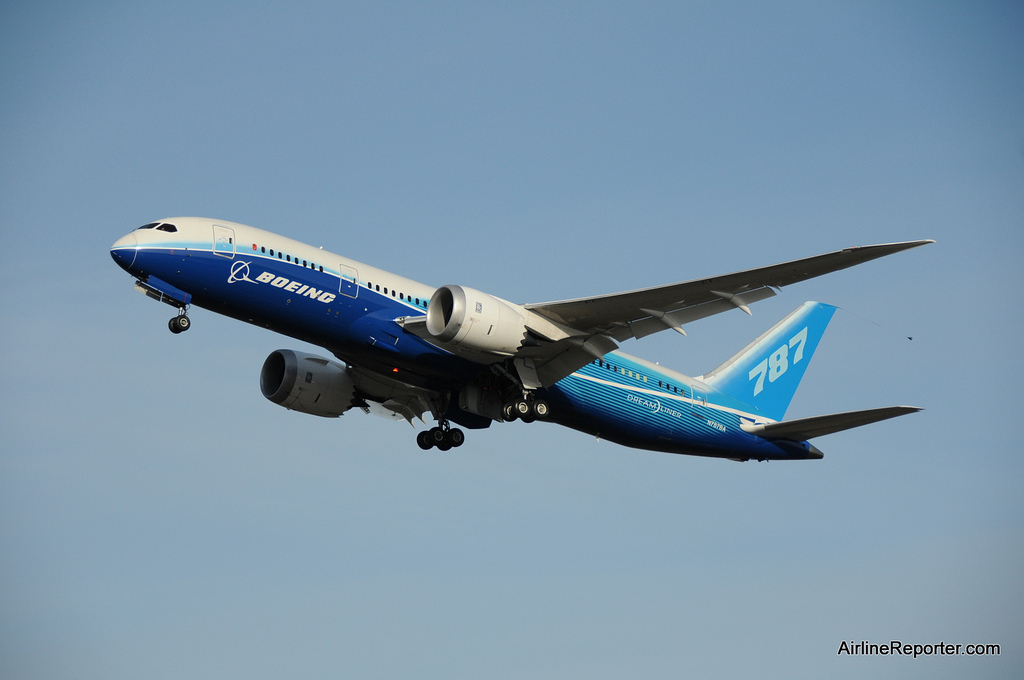
The Boeing 787 Dreamliner Was Almost Called the Global Cruiser

Boeing 787 Dreamliner ZA001 at Paine Field.
What is in a name? Well a lot actually. Could you imagine the Boeing 787 not being called the Dreamliner? Well, it almost happened. The 787 was almost called the Global Cruiser instead.
When the Boeing 787 was first discussed, Boeing named it the 7E7. Randy Tinseth, Vice President , Marketing for Boeing Commercial Planes, describes the naming process on his Randy’s Journal Blog.
Tinseth explains how there were many different naming sessions and workshops to come up with a proper name. After many different sessions and post the trademark and legal teams it seemed that the name Global Cruiser was leading the pack.
Boeing decided to hold a contest to see what the name would be. The finalists were: Dreamliner, Global Cruiser, Stratoclimber, and the eLiner.
Almost 500,000 votes came in from 160 different countries and it was a close race. Counting just votes in the US, the name Global Cruiser would have won. But with all the votes world-wide, the name Dreamliner won by only 2500 votes.
I couldn’t imagine the Dreamliner being named anything else — it fits the aircraft well. Although if Global Cruiser would have won, the DreamLifter probably would have been called the Global Lifter which sounds pretty sweet.
Do you think something would have been lost or gainedwith another name?

Friday, March 4, 2011


​Quantum Aviation Software (Component Control) with Dell Server

Condition: Used - Very Good
Price: $5,000.00

Add to Cart

​Quantum Aviation Software (Component Control) with Dell Server:

Transferable license for up to 6 users.

We are able to recommend an expert installer for turn key operation if needed.

Includes the following modules:


Sales Order
Av-Ref Price Catalog
Purchase Order Customer Quotes
Repair Order Purchase Management
Inventory Mgmt Company Rolodex
Invoice Mgmt Contact Manager
Lot Management Quickbooks Bridge 
Document Imaging Vendor Quotes
Also included:

Fax Maker - FAX Integration
CPTEC Backup
Modules not included
Rental & Leasing
Aircraft Maintenance
Shipping Mgmt
Work Order/Warranty Claims
Demand Planning
Manufacturing
Dell Server Specs:

Model: PowerEdge 1800 (2006)

Microsoft Server 2003
To see Server specs go to:

http://support.dell.com/support/topics/global.aspx/support/my_systems_info/details?c=us&cs=555&l=en&s=dfb&~ck=anavml&~tab=2  and type service code BZVK361 in the box.

Additional Equipment:

Linux Firewall with PC
Netgear Switch
APS Battery backup 
Asking price: $5,000  

Pedro (Pete) Alvarez 
pedro@philipair.com 
Tel 305-667-4488  / Fax 786-232-4144 
www.philipair.com